
A bright, unfussy fruit match-3 built around filling customer orders at a juice stand.
Juice Jam is the smallest game covered on this site and that is precisely its appeal. It is a bright, straightforward fruit match-3 built around filling customer orders at a juice stand, with none of the sprawling event calendars and season passes that the bigger titles have accumulated. If the giants have started to feel like a second job, this is the antidote.
How it plays
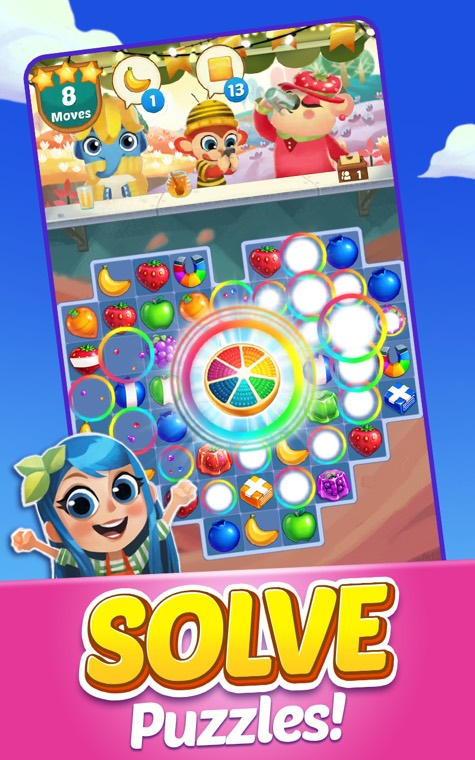
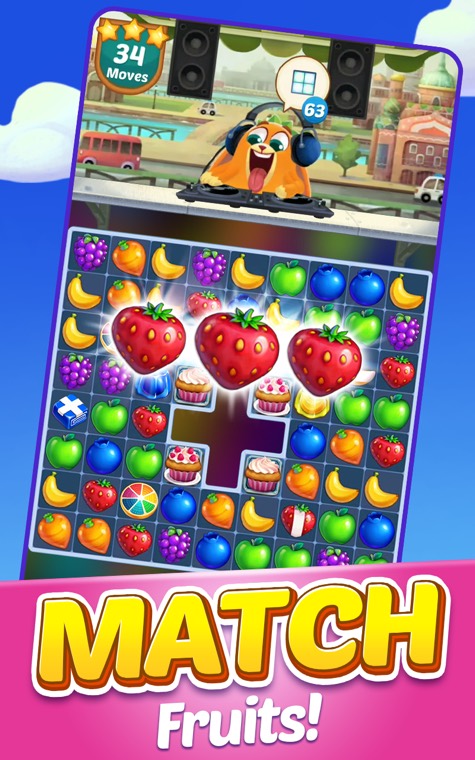
Swap two adjacent fruit to line up three or more. The orders you need to fill are shown at the top of the screen, and the level ends when you complete them or run out of moves. Matching four or more creates a special piece — a directional clear from a line of four, an area blast from an L or square, and a colour-clearing piece from a line of five — and combining two of them produces a considerably larger effect.
None of that will surprise anyone who has played a match-3 before, and the game does not pretend otherwise. What it does well is stay out of the way.
Orders, not scores
Like Farm Heroes, Juice Jam is a collection game rather than a scoring one: the level tells you which fruit it wants and how many, and everything else is noise. The list is usually shorter than in Farm Heroes, which makes levels quicker but also means a couple of wasted moves matter proportionally more.
The one habit that matters. Look at the order list, pick the fruit you need most of, and scan the bottom two rows for it specifically. That single routine will carry you a very long way in this game.
Obstacles
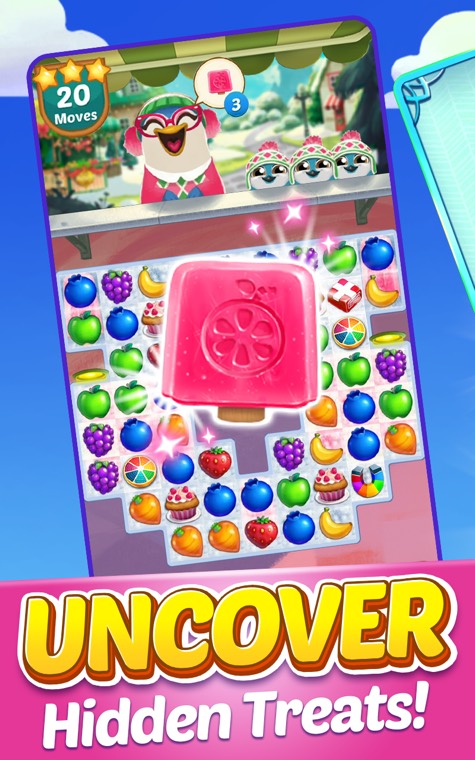
The obstacle set is conventional and introduced gradually — jelly-style coverings that need a match on top, crates that break from adjacent clears, locked pieces that need to be freed first. Nothing here is novel, but the introduction pacing is sensible and you are rarely asked to handle two new mechanics in the same level.
Where it sits against the giants
Juice Jam has around ten million installs against the hundreds of millions of the games above it, and the gap shows in polish rather than in quality of play. Animations are a step behind Playrix's, and the level count is smaller. In exchange you get a game that is markedly less insistent: fewer pop-ups, a lighter event schedule and less pressure at the moment you fail a level.
The five-life system is the genre standard here too, and the same commercial offers appear when you fail, but the volume of it is lower than in the market leaders.
Does it hold up?
As a main game, it is outclassed by the four biggest titles on depth and production. As a second game — the one you open when you want five quiet minutes without a season pass shouting at you — it is genuinely good, and its 4.4 rating across 362,000 reviews suggests plenty of people use it exactly that way.
Tips that actually made a difference
- Read the order list first. The level is asking for specific fruit. Any move that does not serve the list is a move you may need later.
- Prioritise the scarcest fruit. If one required fruit is all over the board and another is rare, spend early moves on the rare one. The common one will still be there.
- Match low. Pieces fall downward, so a match near the bottom reshuffles the whole board above it and often produces a free second match.
- Combine specials rather than spending them. Two special pieces swapped together clear far more than the same two used separately a few moves apart.
- Free locked pieces early. A piece you cannot move is a hole in your options for the entire level. Clearing the lock in the first few moves widens everything afterwards.
- Do not chase big matches for their own sake. This is a collection game, not a scoring game. An eight-piece match of fruit you do not need is worth nothing.
- Let cascades finish. Chain reactions often complete part of your order for free. Tapping ahead of the animation means you never see what you already got.
The honest summary
What works
- Clean, unfussy and far less pushy than the market leaders
- Short levels and quick loading — ideal for brief sessions
- Order-based objectives are clear and easy to plan around
- Sensible pacing when introducing new obstacles
- Small install size and undemanding on older phones
What grates
- Noticeably less polished than the Playrix and King titles
- Smaller level count and thinner meta layer
- Mechanically familiar — nothing here is new
- Smaller player base means less active community help
Verdict. The quiet option. It will not be anyone's favourite game of the year, but it is a well-behaved, uncomplicated fruit match-3 that respects your time — and among free casual puzzles that is rarer than it should be.
Download. Juice Jam is free to install from Google Play and contains optional in-app purchases. The link below points at the official listing by Jam City and earns us nothing.