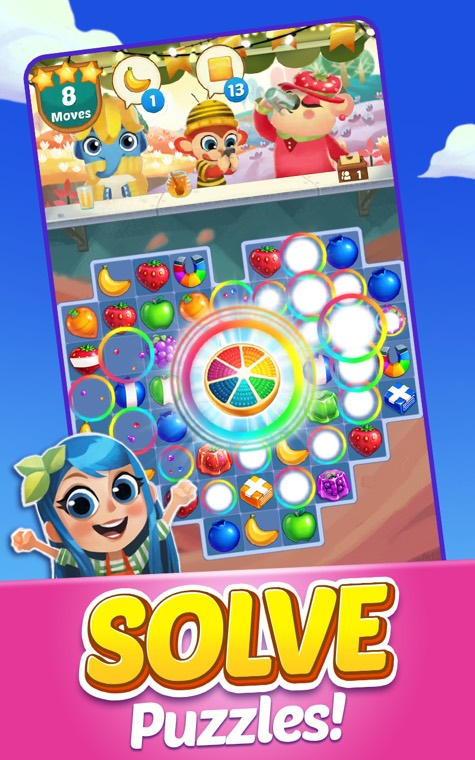
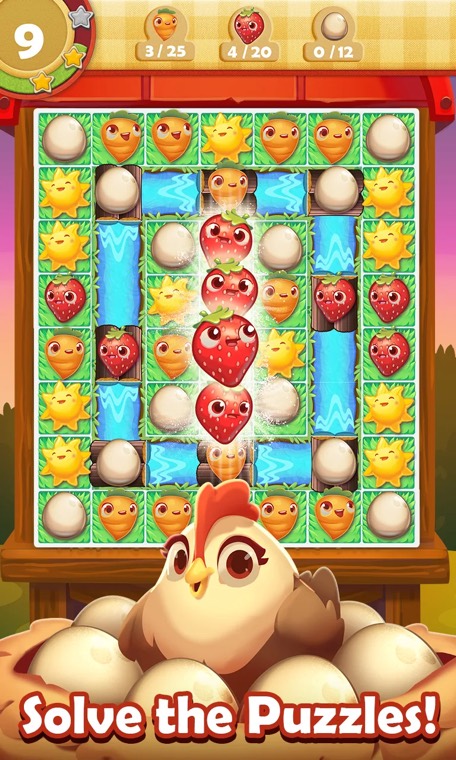
The match-3 that stopped caring about points and asked you to fill a shopping list instead.
Farm Heroes Saga is the most under-rated game on this site, and the reason is that it looks exactly like every other match-3 while playing quite differently. The board is a grid, you swap adjacent pieces, three in a line clears — so far, entirely familiar. The twist is what happens next, and it is significant enough that players arriving from other match-3 games routinely play the first fifty levels badly without understanding why.
You are filling a list, not scoring points
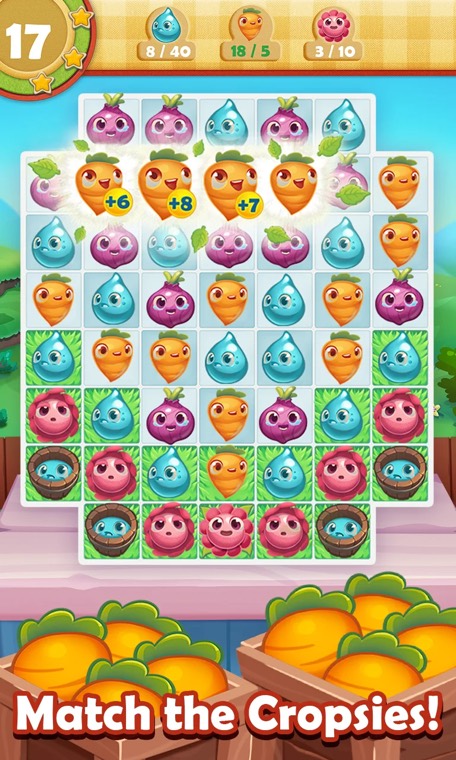
Almost every match-3 asks you to reach a score. Farm Heroes asks you to collect quotas: twelve apples, ten carrots, eight onions, within a move limit. The counters sit at the top of the screen and they are the entire game.
The consequence is immediate and it is the thing most new players miss: the biggest match on the board is frequently the wrong move, because it is made of something you have already collected enough of. Clearing eight apples when you needed one more onion is a wasted turn, and in a tight level that is the difference between a clear and a restart.
The habit to build. Before every move, glance at the counters, not the board. Ask which Cropsie you still need, then look for that colour specifically. It feels slow for about ten levels and then becomes automatic.
Growing is more valuable than clearing
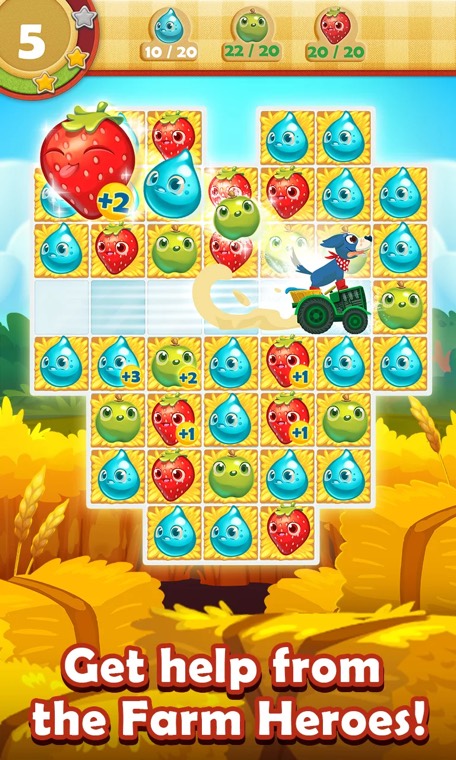
Here is the mechanic that makes the game genuinely interesting. Matching four or more pieces does not simply clear them — it grows the remaining Cropsies of that type on the board, raising the number printed on each one. A grown apple counts as two or three towards your quota instead of one.
So the strong play is often a two-step plan: make a large match to grow the pieces you need, then collect the grown pieces on a later turn. A five-match that grows six apples to double value is worth far more than two separate three-matches that collect six ordinary apples.
Water buckets do the same job more directly — collecting water grows Cropsies across the board — and on levels where water appears, prioritising it early usually pays for itself several times over.
The obstacles and the raccoon
The obstacle set is standard for the genre — ice, grass, mushrooms that spread if ignored, hay bales that must be hit repeatedly. The one distinctive addition is Rancid the raccoon, who appears on periodic boss levels and steals from your collection while you play. Those levels are a straight race: collect faster than he takes, and prioritise anything that damages him directly.
Mushrooms deserve a specific warning. Like chocolate in other games, they spread every turn you fail to clear them. One ignored mushroom becomes a board full of them within six moves, and the level is effectively over at that point.
Difficulty and generosity
Farm Heroes is comparatively kind. The quota system means levels tend to fail narrowly rather than catastrophically, and the game gives you a reasonable idea of how close you came. The five-life system is the genre standard, and King's usual episode-boundary difficulty spikes are present, though less pronounced than in the Candy Crush line.
The interface carries the accumulated events, passes and pop-ups that any long-running King title does. It is the main thing to endure on first launch.
Does it hold up?
Yes, and it is the most strategic game covered on this site. The collection-and-growth system rewards planning in a way that pure score-chasing does not, and once it clicks, going back to a score-based match-3 feels slightly flat. It deserves a much better reputation than "the farm one".
Tips that actually made a difference
- Check the counters before the board. Every wasted move in this game starts with matching something you no longer need. The counters are at the top for a reason.
- Make big matches to grow, not to clear. Four or more grows the remaining Cropsies of that type. Growing six apples to double value beats collecting six ordinary ones.
- Chase water buckets early. Water grows Cropsies across the whole board. On any level where it appears, collecting it in the first few moves usually pays for itself.
- Kill mushrooms immediately. They spread every turn they are left alone. One ignored mushroom becomes an unplayable board within about six moves.
- Work from the bottom row upward. Pieces fall downward, so a low match rearranges everything above it and often produces a free follow-up match.
- On Rancid levels, hit the raccoon first. He removes from your collection while you play. Damage to him is worth more than collection you are about to lose.
- Leave the plentiful Cropsie until last. If one type is everywhere and another is scarce, spend your early moves on the scarce one — the common one will still be there at the end.
The honest summary
What works
- Collection-and-growth system is genuinely strategic
- Failures tend to be narrow, so progress feels fair
- Water and growth mechanics create satisfying two-step plans
- Gentler difficulty curve than the Candy Crush line
- Runs well on modest Android hardware
What grates
- Looks generic enough that people skip it
- Interface is cluttered with events, passes and pop-ups
- Mushroom levels can spiral out of control very fast
- Boss levels are more about speed than thought
Verdict. The thinking player's match-3 and the most rewarding game on this site once the growth mechanic clicks. Spend the first ten levels deliberately checking the counters before every move and it will click faster.
Download. Farm Heroes Saga is free to install from Google Play and contains optional in-app purchases. The link below points at the official listing by King and earns us nothing.