


Match-3 levels that pay for a garden renovation, narrated by the most patient butler in gaming.
Gardenscapes carries a 4.6 rating across more than thirteen million reviews, which makes it the best-received game covered anywhere on this site. It earns that, but not primarily on the strength of its match-3 — which is competent rather than remarkable. It earns it because Playrix understood something the rest of the genre took years to catch up on: people will happily clear a hundred puzzle levels if each one visibly builds something.
The loop
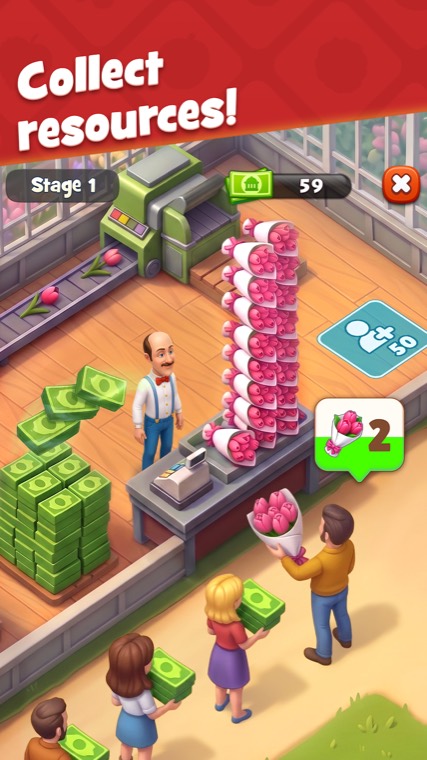
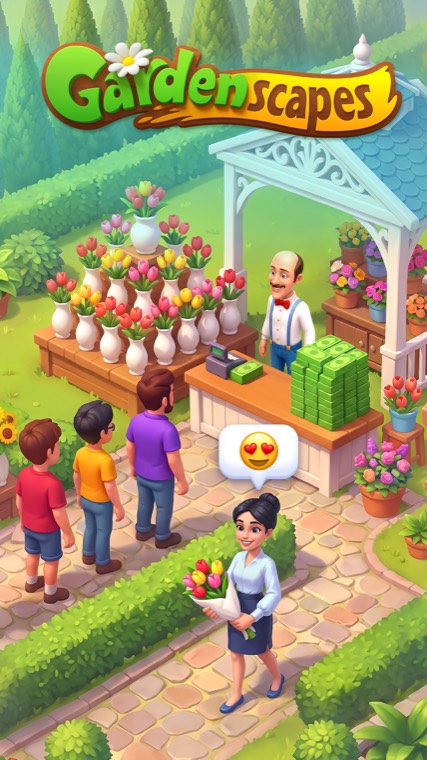
Clear a match-3 level, earn a star. Spend stars on tasks in the garden — clearing rubble, repairing a fountain, choosing new furniture, planting beds. Austin, your relentlessly cheerful butler, narrates the whole thing and nudges you towards the next task. Repeat.
It is a simple structure and it works far better than it should. The garden changes visibly, you choose between decorating options so the result feels partly yours, and there is always a specific next thing rather than an abstract level number.
The match-3 underneath
The puzzle itself is a conventional swap match-3. Line up three or more; four in a row makes a firecracker that clears a line; an L or T shape makes a bomb that blows out an area; larger arrangements make bigger area effects; five in a line makes a rainbow blast that removes an entire colour. Combining two of them produces a substantially larger effect, and the combination animations are among the most satisfying in the genre.
The rule that most improves your clear rate. Combine, always. A bomb swapped into a firecracker is worth several separate uses of either. Playrix designs levels expecting you to build combinations, which is why players who never combine find the middle stretch unreasonably hard.
Objectives and obstacles
Levels ask for specific outcomes — collect a number of items, drop apples to the bottom row, clear grass from marked squares, break through layered obstacles. The obstacle set expands steadily and each new type gets a level or two of practice before it is combined with others.
The difficulty curve is well shaped for roughly the first hundred levels and then becomes noticeably steeper. That is deliberate and it is where the game's commercial design starts to be visible.
The money question
Gardenscapes is free and completable without spending, but it is not shy. Failed levels produce offers of extra moves for coins; coins can be bought; and the mid-game deliberately places harder levels at points where you are one star short of a task you have been anticipating. That is well-executed persuasion rather than anything improper, and knowing it is coming makes it easy to decline.
Playrix is, to its credit, calmer about this than the genre average. There is no timer-driven panic screen and the game does not gate garden progress behind a purchase.
Does it hold up?
It is the most complete package on this site. The puzzle is solid, the renovation is genuinely charming, the production values are high and the whole thing is more relaxing than its competitors. If you want one casual game to keep installed for a year, this is a very defensible choice.
Tips that actually made a difference
- Always combine power-ups. Playrix levels are balanced assuming you will. Two combined pieces are worth several separate uses, and the mid-game gets much harder if you never do it.
- Read the objective, then plan backwards. On apple-drop levels, only pieces below the apple matter. On grass levels, only matches on marked squares count. The board is not the goal — the panel is.
- Work the bottom two rows. Gravity is free leverage. A low match reshuffles everything above it and frequently produces cascades you did not plan.
- Spend stars on one area at a time. Spreading stars across several unfinished tasks makes the garden look like a building site for hours. Finish one area, then start the next.
- Save the rainbow blast for a blocking colour. Using it on whatever colour is most common is instinctive and usually wrong. Use it on the colour standing between you and the objective.
- Restart a level that opens badly. Levels are short. Two bad opening moves are worth restarting rather than grinding out a near-certain failure.
- Ignore the events if you want to. Nothing in the season pass or timed events is required to progress the garden. The core loop works entirely on its own.
The honest summary
What works
- Renovation meta gives every star a visible, satisfying purpose
- High production values — animation, art and sound are a clear step up
- Power-up combinations are large, legible and fun
- Calmer and less pushy than most free-to-play competitors
- Enormous amount of content for a free install
What grates
- The match-3 itself is competent rather than inventive
- Difficulty steepens sharply after roughly level 100
- Austin's dialogue wears thin long before the garden is finished
- Large download and heavier on older phones than its rivals
Verdict. The most complete casual game on this site and the easiest to recommend to someone who wants a long-term project rather than a quick puzzle. Learn to combine power-ups early — everything after level 100 assumes you will.
Download. Gardenscapes is free to install from Google Play and contains optional in-app purchases. The link below points at the official listing by Playrix and earns us nothing.